I've always had a fascination with tiny cars...or motorbikes that have aspirations to be cars. I was recently in Bloxwich at a sweet little tat shop and saw two Sinclair C5's. I am sorely tempted to go back and buy one to do some sort of project with...maybe a lands end to john o'groats record attempt or some sort of supercharged version. It would be a sweet vehicle to have a tailgate party with...any suggestions?
Monday, 22 August 2011

Thursday, 18 August 2011
Banks's Distribution Centre
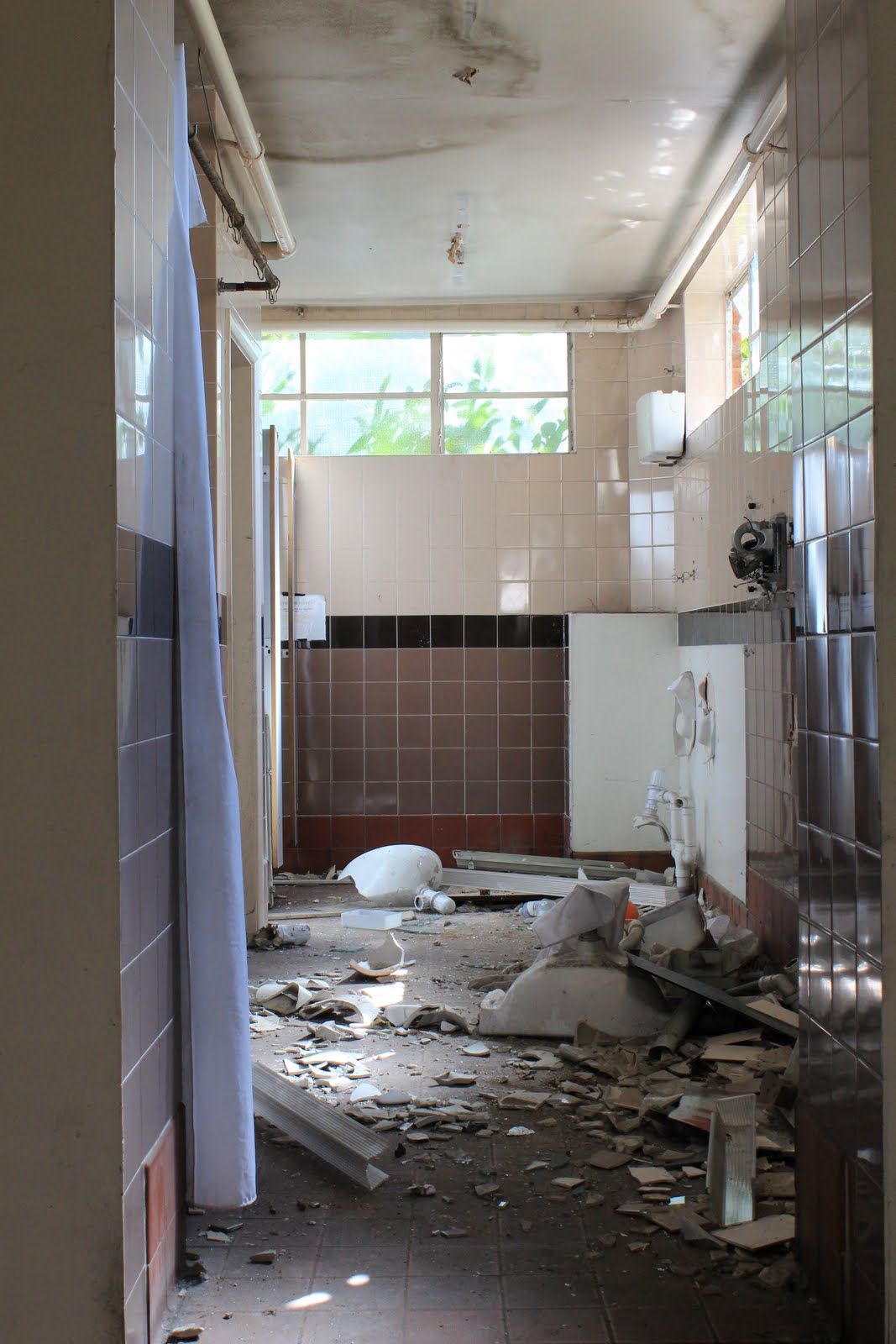
You can dere-lict my balls! Yet another abandoned warehouse in Wolvo. Whenever Matt and I meet up we seem to end up in a new one these days just as a matter of course, by wandering around the backstreets one can' help but be drawn into getting into these places...as is evidenced by the stark evidence that others have used this as an urban playground by painting art and/or smashing it up, as a hang out to get drunk and take drugs in as evidenced by the white cider bottles and syringes, or even to live in as evidenced by the bedding, food and shit in the toilets. This was quite a interesting one, the old Banks's Brewery Distribution Centre just outside the ring road. It had several different types of space, warehouse, office, communal, garages and each had bizarre add ons like a wierd mezzanine floor that had been put in one of the larger warehouses to split it into two levels not much more than 5ft high...



Wednesday, 17 August 2011
St. Louis - The Space between the Buildings
One of the things that really impressed me about St. Louis was the quantity and quality of public areas from the large civic parks to little green oasis’ nestled amongst the towers and flyovers of downtown. And, maybe more important than the quantity of them, was their situation in the urban fabric which meant they weren’t just isolated outposts of nature but a small part in a city bursting with outdoor life. This was demonstrated well over the 4th July weekend when people lined up along the street edge of the park from 8 in the morning to get a spot for the procession of marching bands, cheerleaders and, bizarre wrinkled Fez wearing old men in tiny cars, The Shriners. Once the park edges were full people found spots on the green verges of the normally busy road eventually linking all the way up to the next park. In effect a temporary linear park a couple of miles long was created focusing around the regular nuclei of the permanent parks.
It isn’t that I haven’t experience this in cities before, with the exception of the Shriners nothing was new about plenty of regular, quality open spaces. Split in Croatia and Norwich are two of my favourite cities I have visited and they both display myriad little public places and opens areas with their tight urban grain. But there lies the contrast which makes St. Louis so exciting to me, Norwich and Split are haphazard essentially medieval towns with rambling streets breaking up the logic of the onetime grid. The pedestrian scale of the cities and their ad hoc development lends itself to the creation of pleasant outdoor spaces. They are the sorts of place that Jan Gehl might have cited jubilantly in his book “The Life Between Buildings.” St. Louis on the other hand at first appears to be what Jan Gehl might term a “lifeless city”, the dull, monotonous automobile reliant cities of the modern west...
“...the city with multi-story buildings, underground car parking facilities, extensive automobile traffic, and long distances between buildings and functions...can be found in a number of North American and ‘modernised’ European cities and in many suburban areas. In such cities one sees building and cars, but few people, if any, because conditions for outdoor stays in the public areas near buildings are very poor. Outdoor spaces are large and impersonal. With great distances in the urban plan, there is nothing much to experience outdoors, and the few activities that do take place are spread out in time and space...under these conditions most residents prefer to remain indoors...”
This description could certainly be applied to Kansas City and Detroit and whilst the situation of open no mans land and abandoned warehouses can be found on the edge of St. Louis and the towers and vast parking lots were prevalent in the “downtown” the distances in the urban plan were by no means great. Every time a new park was reached it seemed to break the short distances up into very short distances as Jan Gehl points out...
“A walking network with alternating street spaces and small squares will have the psychological effect of making the walking distances seem shorter...”
But merely having plenty of open area doesn’t instantly create a pleasant place to occupy, infact an open barren place is more inhospitable then no space at all. The vast plazas of Millennium Point and Centenary Square in Birmingham can testify. Birmingham is a good example of an automobile reliant city, especially if you consider it as part of the Black Country conurbation as opposed to a single component. Both St. Louis and Brum are motowns, so the “walking network” Gehl talks about isn’t necessarily applicable. This is an idea explored further in Deyan Sudjic’s “100 Mile City.”
“This new species of city is not an accretion of streets and squares that can be comprehended by the pedestrian...it took Reyner Banham to point out that the freeway is as much a part of the urban space as the civic square.”
For opens spaces to thrive as a place for occupation, and urban recreation in a city such as this, a city like St. Louis, they must necessarily be well designed and offer different types of space to allow potential for different activities to occur.
Whilst the refined grandeur of the central civic park and the vast open area of the “Jefferson Expansion Memorial Park” which is good for mass cultural events are very important it is the many small scale plazas amongst the office blocks which made St. Louis special for me.
Deyan Sudjic and Jan Gehl both criticise downtown plazas as being too often predominantly unwelcoming places with a lack of appropriate street furniture and full of downdraughts and shadows caused by the surrounding towers.
“...between 1961 and 1975, 1.1million square feet of plazas were created in New York...rising above the old ornate skyscrapers of the 1930’s came a new, more anaemic crop of glass boxes, floating above their plazas...it soon became clear that some of the new plazas were far from the civilised urbane spaces their enthusiasts had promised. Downdraughts made many too uncomfortable even to cross, let alone to linger in. There was often nowhere to sit, some owners even breached the terms of their zoning bonuses by fencing off their plazas.”
“The Social Life of Small Urban Spaces” by William H. Whyte documents these plazas and explore some of the reasons why they aren’t always successful.
With all this to contend with it shows how well designed the St. Louis parks have to be. The plazas of St. Louis featured plenty of seating both along the edges of the street and within more introvert central areas amongst planting that effectively protects the sitter from any draughts. Raised beds and earth bunds, as well as adding interest, sheltered other areas of seating from draughts. More open areas address the building frontages allowing for the functions of the building to spill out into the plaza. And of course the ubiquitous Charlie Dimmock water features drowning out some of the vehicular noise. These are all features that could be found in a poorly designed plaza also. The proof that in St. Louis these elements are arranged amicably is that the parks and plazas are very well used and by a broad demographic. Everyone from the homeless vagrants, one of whom spent his day doing intense physical training in the burning sun informing people he was bi-polar, to old dears with lap dogs watching their grandchildren squealing through the fountains and the young couples smooching under the trees.


Seeing such a broad range of people using the parks is perhaps slightly surprising considering the way “public space” has become increasingly privatised. For better or for worse I can’t imagine the heavies of Brindley Non-Place allowing a “bum” to sleep on the grass and then wake up to leer at some foxy professional lady passing by.
It is increasingly common for public spaces to become privatised and they are often distinctly undemocratic. It is a theme explored by Larry R. Ford in his book “The Spaces between Buildings”
“...the incursion of private business into the public space raises interesting questions. Shall businesses have the right to refuse entry or even chase away ‘unacceptable’ people from public space?”
Often public space is very noticeably “middle class” or “skanky” with no mixing. Either the uncouth are moved on or they are left to the outside whilst the great and the good retreat indoors which Larry Ford describes as...
“...the city as fortress syndrome...a mass of interconnected, towering structures with little or no visible life on the street. To the extent that private building interiors serve as public space, real public exterior space becomes impoverished and ignored. Behaviour is carefully monitored in the atria and walkways, and peole who are deemed unacceptable are often barred...as the streets and civic plazas become more deserted (and so, dangerous) people flock to the protective cocoon of inside walkways for safety and protection from undesirables, who are kept out...no one of any importance walks in the streets.”

This is something I witnessed in Detroit where aerial walkways and interior streets connected many of the buildings leaving only a terrifying collection of people on the streets.
Whilst this situation might almost be desirable by an egotistical architect as it keeps people inside his/her building it cannot be good for the city and the residents. Alan Berger writes in “Drosscape: Wasting Land in Urban America” that
“...people do not want to spend twenty four hours a day in the same type of designed environment. It is easy to understand how these activities {flashmobs, critical mass etc.} take advantage of a citys landscape leftovers because urban open space is increasingly being privatised. In the urbanised world, the in between landscapes should be valued because it provides a threshold, a platform for luminal cultural phenomena to play out. Thus communitas is cultivated.”
Perhaps what made St. Louis so enjoyable was there was the sort of baggy “waste land” spaces waiting for activities to occupy them AND there was also well designed plazas that allowed anyone and everyone to use them. St. Louis had a distinctly post-industrial landscape full of pockets of “waste” and it was so exciting to see areas where people had used the opportunity provided by the latent potential in the drosscape and more excitingly still there was still loads of potential waiting to be unlocked from the vast swathes on wasteland on the edge of the downtown. St. Louis was the sort of town when one literally would want to “watch this space.”
Tuesday, 16 August 2011
St. Louis

I really liked St. Louis. It was like a hotter, more humid version of Birmingham when Birmingham still had lots of quality music clubs before the council started closing them all down. Because of the overpowering humidity the evenings had a rich colour and scent to them and everyone spent a lot of time outdoors. The dilapidated part of town that the hostel was in was full of shared rear gardens, shared wooden external staircases and bars playing amazing blues music in little outdoor courtyards nestled amongst the abandoned warehouses down by the post-industrial zones. They were all full of people just sitting out, talking, drinking, watching the glow bugs etc. A bit like Digbeth but with far more on offer. Then in the downtown there were real fancy bars and clubs full of very elegantly dressed attractive young people with lots of cash...a lot more classy than Brum’s Broad Street.
Here are a few photos of the hostel I stayed in that give an idea of the rich hazy colours of the humid downtrodden little place. Although the haze at the hostel may well have been produced by the ageing hippy’s spliffs.


Sunday, 24 July 2011
America - Fuck Yeah!

The red white and blue was everywhere. Admittedly everywhere was gearing up for the 4th July...or July 4th celebrations but I got the impression that most of the flags would be staying up beyond Independence Day.
Everywhere I went I had people looking at me quizzically and asking where I was from, or asking it through the statement of “you ain’t from round here, are you?” I would say that no I was from England, “oh London, why have you got an Australian accent then? Well welcome to the USA sir” they’d say before generally asking me how I found the Royal family was working out for me, what exactly the crown jewels were or if I knew Harry Potter. Sure did make me feel proud to be British.
Patriotism was particularly noticeable at the baseball games I went to where before the match we all had to stand up and take off our hats for the Stars and Stripes to be sung towards the flag. This was followed by God Bless America and much whooping, hollering and fist pumping. It made me laugh to think of what would happen if they tried to make the fans at the Molineux stand to sing God Save the Queen at a normal premier league football match.


Saturday, 23 July 2011
Things I learnt in the USA
The first thing I discovered is that it is impossible to write a blog whilst travelling, I have no idea how people do it other than if they aren't going out and discovering things, meeting people and just staying cooped up in their rooms instead. I really wanted to keep up dated on here as I went but it was way more productive to go off with people I met in the hostel or out to the ballgame or whatever so I didn't. I might do some retrospective blogs as I go through my photos I suppose but I guess that defeats the whole point of blogging. meh.
The other thing I discovered is that Mountain Dew is far far better in the USA than it is back in Blighty. Literally toxic...and check this out for a perception challenging advert! sweet
Thursday, 21 July 2011
Subscribe to:
Posts (Atom)